Beyond the wholesale model

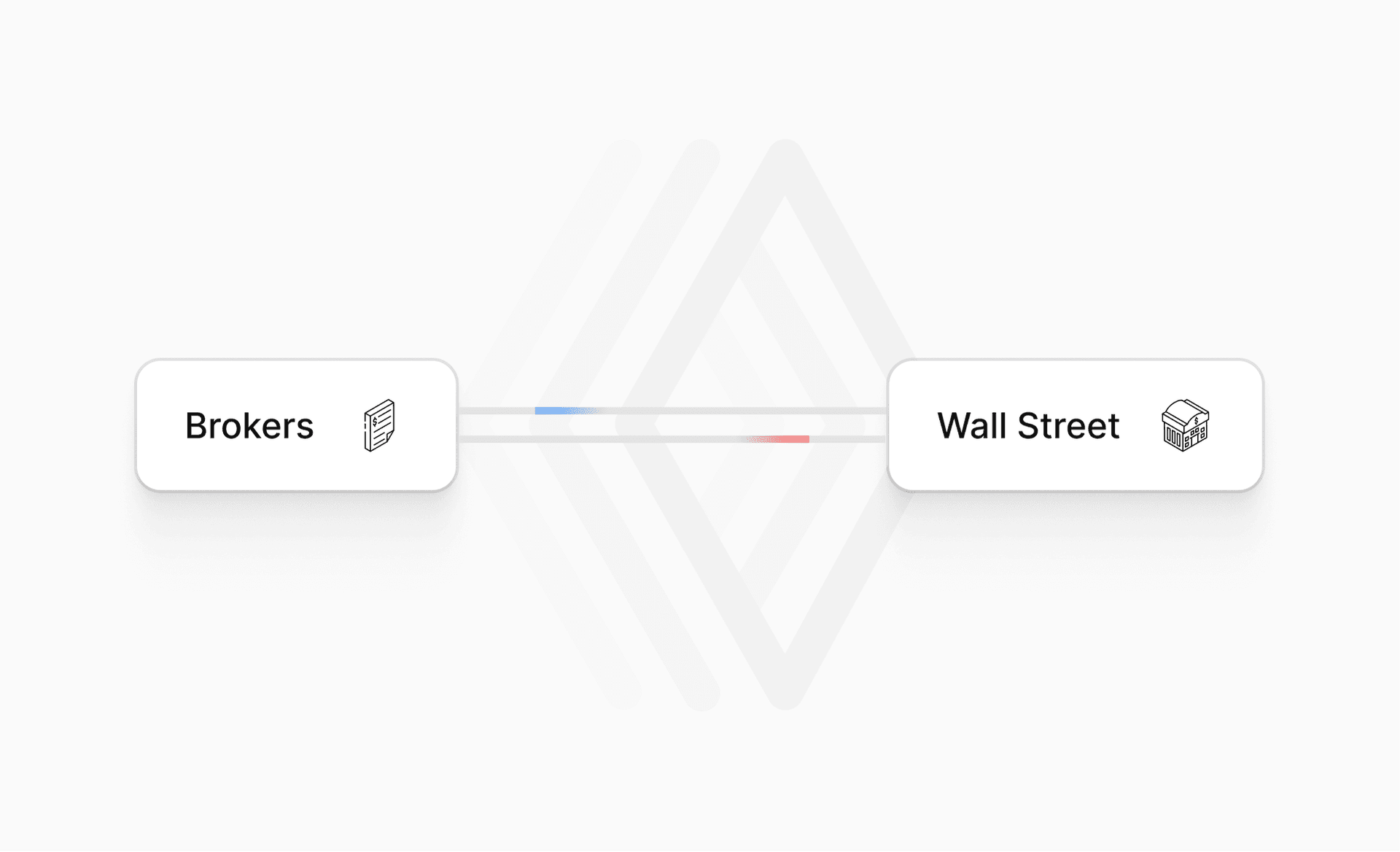
Brokers and non-delegated lenders often assume that Pylon is a wholesaler, just with superior technology and tighter margins. This is understandable but incorrect.
Pylon does replace the functionality of wholesale lenders (and then some). But our lower rates and stronger execution are the result of a fundamentally different operating model.
What wholesalers actually charge for
Wholesalers add two layers of markup on top of the true cost of capital. Brokers pay for both.
The first is intermediated capital. Most wholesalers don’t sell loans directly to institutional investors. They sell to one or more layers of aggregators or correspondent investors, who in turn sell to institutional investors. Each middleman takes a spread. By the time the wholesaler’s own margin is added on, the broker’s rate sheet contains a sizable markup.
The second layer of markup is mortgage manufacturing. Inside the wholesaler is a fully staffed mortgage factory: processors, underwriters, closers, post-closing teams, account executives, account managers, underwriting managers, compliance staff, and IT, plus 15-20 vendor systems to keep it all running. The Mortgage Bankers Association puts the industry average production cost at over $11,000 per loan. That cost is recovered through additional markup on the rate, plus fulfillment fees, plus the wholesaler’s operating margin, plus a buffer for rep and warrant exposure.
A broker pricing a loan through a wholesaler is paying for far more than the true cost of capital.
What Pylon’s “direct Wall Street rates” actually means
When we say that we offer direct Wall Street rates, it means two things.
The first is that we cut out capital markets intermediaries. We have direct relationships with the largest institutional investors. Brokers and non-dels on our platform can connect to these investors without aggregators or correspondent spreads in between. Because we pool volume across all of our customers, our execution rivals that of the largest mortgage lenders in the country. Any originator on Pylon prices loans against a similar cost of capital to a top-twenty IMB.
The second way we deliver direct Wall Street rates is by eliminating the mortgage manufacturing markup. Our cost to originate is far less than industry average because we automate mortgages rather than “manufacturing” them. Our software does the work that a wholesaler’s staff, vendors, and fragmented systems do, and this allows us to pass the true cost of capital to brokers without the wholesaler markup.
These two differences together are what’s behind our 75-200bps pricing advantage. Rather than a margin choice we’re making, it’s the difference between buying a loan from a mortgage factory and originating one on AI-native infrastructure plugged directly into Wall Street.
We replace the broker’s software stack
Pylon’s mortgage rails include all the functionality brokers need to originate mortgages, including what’s contained in their POS, LOS, and PPE.
In the traditional broker stack, these tools are independent products. The POS gathers borrower information. The LOS runs files through processing. The PPE returns pricing options. Each has its own data model and most do not validate files against the wholesaler’s underwriting guidelines in real time. The result is the guess-and-check workflow loan officers know well: structure the loan, run AUS, see what breaks, restructure, re-run, then eventually export the file and upload it to the wholesaler portal for underwriting review.
On Pylon, these layers are consolidated into one platform. Our system evaluates every permutation of LTV, DTI, and down payment across live rate sheets and surfaces the best structures for the borrower. Investor guidelines are encoded into the platform, so qualification is validated continuously from the first keystroke rather than checked retroactively in underwriting. Conditions are generated programmatically as the file’s state changes. Disclosures are generated automatically. Order-outs run in the background. There is no export step and no wholesaler portal.
As a result, the broker’s own software costs collapse along with the wholesaler markup.
A new paradigm for brokers
Brokers on Pylon keep the same broker license, the same independence, and the same borrower relationships. What changes is their cost structure and workflow. The wholesale lender, the POS, the LOS, and the PPE collapse into a single platform with direct capital markets access and software-driven execution.
Pricing reflects the actual cost of capital, not multiple layers of markup. Underwriting runs deterministically. Pylon takes the rep and warrant exposure. Loans close in 18 days on average.
District Lending, a broker operating on a lead-purchase model, nearly doubled their margin per loan after switching to Pylon. They now run 80% of their conventional volume through Pylon and close in 15 days on average.
The wholesale model exists because mortgages have historically required intermediated capital, manual coordination, and a tech stack to manage both. Pylon streamlines and modernizes this model, giving originators a more efficient operating model and significantly better economics.